How to Tell If a Job Is a Scam: The Signals That Actually Matter
If you’re wondering how to tell if a job is a scam, it’s probably because something about the opportunity feels slightly off.
Maybe the interview felt too easy. Maybe the recruiter moved the conversation to WhatsApp or Telegram. Maybe they asked for personal information earlier than expected. Or maybe everything looked professional. The platform, the email, even the company name. But the process still didn’t feel like a real hiring process.
That uncertainty is exactly where job scams operate.
First let’s get one caveat out of the way. Which is that there is no single indicator that can tell you with 100% or even greater than 70% certainty whether a job is a scam or not. Most cases require multiple confirmatory signals before we can be certain. Most scams become clear through a combination of patterns: how they contact you, how they communicate, what they ask for, and how quickly they try to move you from “candidate” to “compliant participant.”
In this guide, we’ll break down the signals that actually matter and just as importantly, the signals that can look legitimate but don’t prove anything.
Why Job Scams Are Hard to Recognize
Job scams are difficult to recognize because they are designed to look like legitimate hiring processes. In many cases, there is no single signal that clearly identifies something as a scam.
Each job scam unfolds differently. The structure of the scam depends on the industry the job is in, the technical ability of the scam artist and the resources at their disposal to make the process appear legitimate. Because of this, most situations only become clear when multiple signals are considered together.
As a result, individual signals such as: the platform used, the quality of communication, or even the apparent professionalism of the process, are often not enough on their own to determine whether something is real.
Signals That Do NOT Prove a Job Is Legitimate
Because job scams are designed to mimic real hiring processes, many of the signals people rely on to judge whether something is legitimate can be misleading.
It’s common to assume that certain factors such as: how you were contacted, the platform being used, or the apparent professionalism of the process, provide strong confirmation that a job is real. In practice, these signals are often unreliable on their own.
Below are some of the most common signals that can look legitimate, but don’t actually prove anything.
Inbound Versus Outbound
It is important for job seekers to recognize that job scams can happen on both ends of the communication direction. Sometimes, fake recruiters call you with fake job offers and set up elaborate recruitment processes to give a veneer of legitimacy to the con, i.e, a push model. While other times they set up a fake job posting, complete with a fake company, or impersonate a real company and deal with you in all the ways you expect a real company to. I.e, pull model.
Platform Agnostic
Another heuristic people often use to determine if a job is a scam is whether or not the person is communicating via a reputable platform. If you read one of our submissions. We had someone being contacted for a job they believed to be a scam. The person contacted them via LinkedIn and even had a verified premium account. Whether it is LinkedIn, Fiver, or Upwork. Scammers are very sophisticated these days and can set up legitimate seeming accounts to fool users into thinking the opportunity is legitimate. So even if someone contacts you through a legitimate platform, or you see a job posting on such a platform. There is still a risk that the scammers are gaming the platform.
Technical Signals
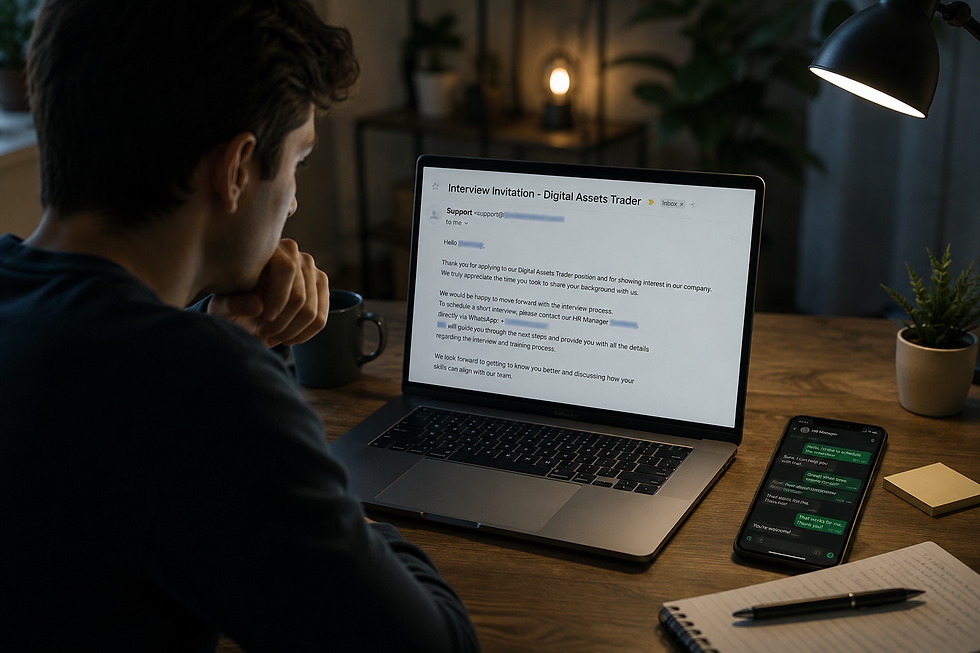
Additionally, some people often think that, if the recruitment process displays high technical ability. Then it is most likely not a scam. This is not true. I.e, whether or not they email you using gmail or a domain that is related to the purported company. This is wrong, we have experienced job scams where they email you using a domain that is linked to the name of the company they are impersonating.
Also complete with auto responses that trigger 3 minutes after you send in an application to confirm receipt of the application. Even in those cases, the job could still be a scam.
Below is an example of an automated response email for a crypto job that turned out to be a scam:

That being said, if you do see red flags in any of these areas you should be extra vigilant for other signals. Because, it does indicate that there is something potentially wrong. However, we say this to highlight that, you could have an experience with a good platform, with someone with a verified account, and the process shows all the technical signs of professionalism, but still end up in a scam. So negative signals in these areas do indicate a scam, but positive signals don't disprove it either.
Signals That Actually Matter
They Move The Communication To Personal Channels
Firstly, one a basic level. Start with the communication channels you are using.
At some point or another, they will want to handle the bulk of the communication using traditionally personal communication channels as opposed to business communications channels. This will be, whatsApp, Signal, Telegram, TextMessage, WeChat & sometimes a phone call. As long as you are handling the communication via what are normally social / personal communication channels, then you are most likely dealing with a scam.
Within this there is a nuance, because indeed, some of the planning and coordination for normal jobs can take place via personal communication channels.
However, the key thing here is that the interview itself cannot be conducted via these channels. There is a lot of laws surrounding interviews and the proper way to treat candidates fairly and companies need to comply with this. For example there are even laws about using AI in the recruitment process. So if the company is serious with you, and serious about being a real company, they will make sure that the interview itself is in some way documented via official channels. That's how they prevent liability.
The Interview Doesn't Feel Like A Real Interview
Secondly, and this is a very important tell. Which is that, there is no real job interview. To explain this, I mean that they are going to organize a meeting with you and call that an interview. But pay very close attention to the questions they ask you. No matter what job it is, if you are going to be hiring someone online or on-site. There is still a certain prerequisite level of capability they expect and certain skills you need to have. Especially also for remote jobs! So if you find yourself in an interview a the company and notice that the interview was too easy, or that they didn’t ask for specific details about things you said. It's more likely that it is a scam.
Think about it from the perspective of the company. Every hire costs them more than the salary they pay the hire. Getting hiring decisions wrong only costs the company more money in payouts, rehiring, disruption of operations and time wastage. It is incredibly costly to hire the wrong person. Even for a remote role, and we would say, especially for a remote role. So they need to get it right the first time. Even if the job doesn’t require high technical ability they will still need to screen you for your emotional regulation, mindset, communication style, dependability etc. As a matter of fact, it's questions like this that actually make or break whether someone gets hired in normal roles. I'm sure we’ve all heard the “not a right fit” excuse. So therefore, for every job interview you go through, you need to ask yourself, was that really an interview?
Remember, the incentive of the scammer is to get you excited. So that you give out your information and follow their instructions. Therefore, they have an incentive to make the interview as easy as possible so that you can get excited and jump straight to the following instructions phase. Whilst for a real company, the incentive is to get the best person possible for the job. A real company will make your interview process hard, while a scam job will try to rush you through that phase as quickly as possible.
This approach is also reliable because it allows you to use your own expertise. As someone applying for a job you also know something about the domain. So you have some idea of the types of questions they will ask you. From a technical perspective you know at least a little bit what is needed even if you can't do the things yourself.
The bottom line is that real jobs make their interview process difficult. Right now in this economy, even basic entry level roles have hundreds of people applying. And we know AI is also here. So there are more job seekers than there are jobs available. So you need to assume that for every role you see, you are not the only one applying. If you are not the only one applying, and the company has multiple candidates to choose from, then they will try and make that interview process slightly difficult and competitive. And even then, they will still do other psychological mindset related questions to ensure the fit is right. So after every interview ask yourself if you were really interviewed or subtly influenced by a line of questioning that didn’t really assess your fit for the role. The conversation will be more about clarifying what you are in for, as opposed to assessing your fit for a role.
The Communication Feels Overly Warm Or Manipulative
Finally, the last signal we will provide here is the communication itself! Remember, at base, scams are social engineering exploits. So therefore, their goal is to build rapport with you! Its after they first build rapport with you that it becomes natural for you to follow whatever instructions they will eventually give you. So during the conversation there will be a lot of redundant polite platitudes. They will do things like compliment you for your openness to their unique approach, and there will be a lot of wishing you a nice day during the conversations. Remember, you’re in a job application and you are conducting business, during the conversation the language will be indeed professional, but overly nice. Below is an example of the end of a conversation for a job. Notice the "thanks" they repeatedly sent. All of that was to trigger an emotional reaction of pleasantness and being nice. Notice also that all of it was being done on whats app and the person was eventually sent to talk to another person. Who this time decided to speak on Telegram.

What To Do When Multiple Signals Appear
At this point, the question is no longer whether you can be 100% certain that something is a scam. In most cases, that level of certainty is not realistically achievable before something goes wrong. The more important question is whether you have seen enough signals to justify continuing the interaction.
Once multiple confirming signals are present, the correct course of action is to disengage completely. This can feel counterintuitive. The natural instinct is to ask more questions, seek confirmation, or even confront the person on the other side. After all, no one wants to miss out on a potential opportunity.
However, continuing the interaction is exactly what allows the situation to develop further.
We say this because job scams are uniquely positioned to take your data. In order for you to get a job, the employer has to know something about the candidate (you). So therefore, we are more likely to give away our information in the context of a job inquiry.
If you stop responding, the interaction cannot progress. In most cases, they will attempt to follow up. But if there is no engagement, communication will eventually stop. This approach is not about proving that something is a scam. It is about limiting your exposure once the situation shows enough signs of uncertainty.
If You Want To Understand Your Situation More Clearly
At this point, most people are no longer asking whether job scams exist.
The real question becomes:
“What does my specific situation actually mean?”
Because while these patterns are consistent, the way they play out can feel personal. Especially when conversations involve your background, your experience, and your information.
If you want a clearer breakdown of how these interactions work in practice, we run a live session where we go through real job scam scenarios step by step.
This includes:
how to interpret communication patterns in real conversations
what different types of “interviews” actually indicate
what it means when they ask for certain types of information
how these situations typically develop over time
The goal is not just to explain job scams, but to help you understand what your situation actually means. And what usually happens next.
Additionally, if you want to read more about the ambiguous nature of job scams, read our Boadsi article next.


Comments